Saturday, July 30, 2011

Tower of London

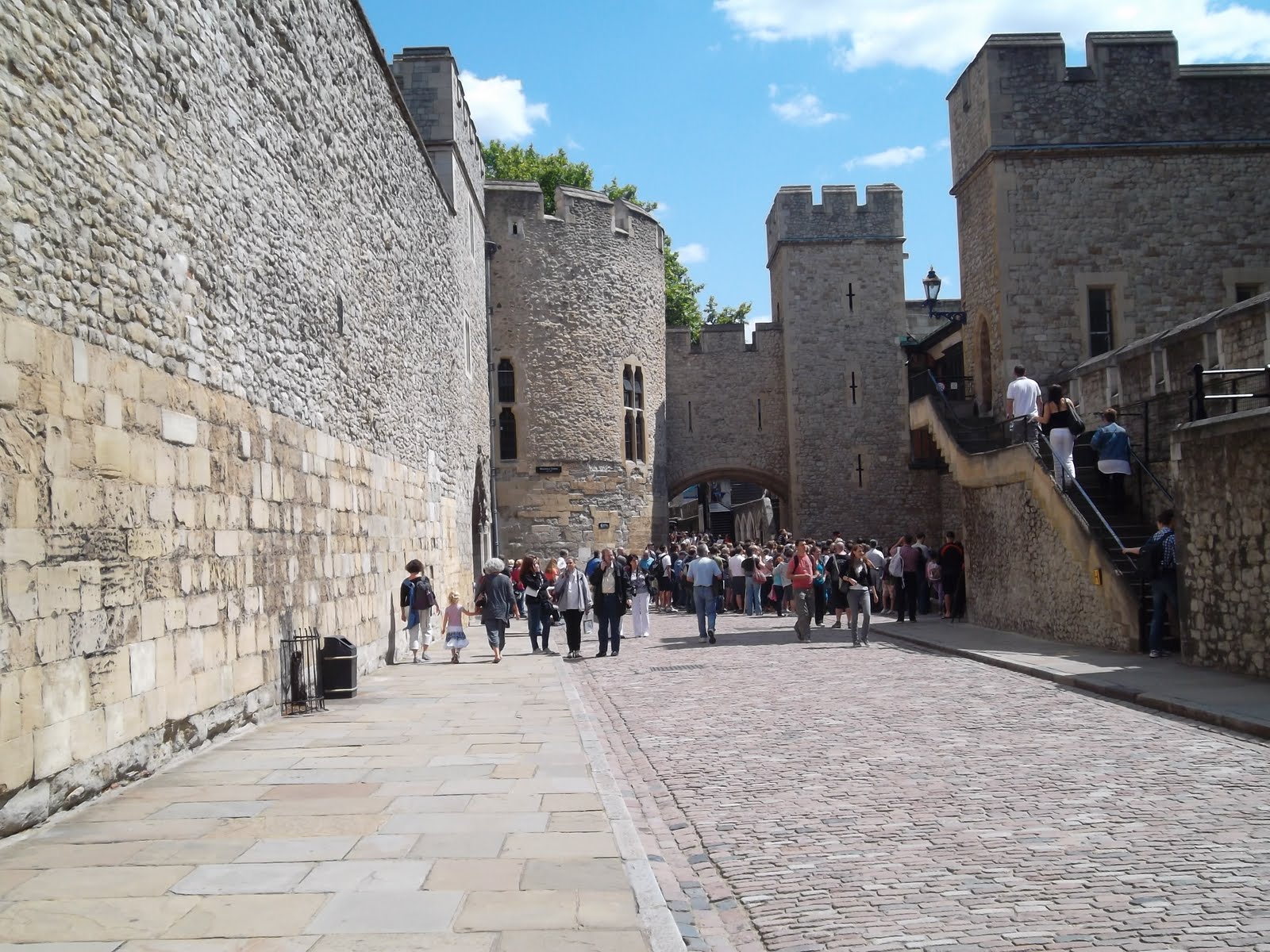
During my visit to the Tower of London I entered into the Broad Arrow Tower. A unique name for an interesting place. Inside laid an adventure of what had taken place and what was used in case of an attack. I was guided through with instructions on the wall.


“In case of attack, assemble on wooden fighting platform.” This was a quote from one of the signs not shown here.


This wooden platform had enough space for two people to walk side by side and the back side was blocked off by a several pieces of wood stacked on one another. 


On the tables were weapons that the men who would have been stationed here to take. On this table there is a crossbow and a pocket of arrows prepared for an attack. 

As I walked across the platform I could hear the sounds of clinging swords as if men had begun to fight. The snarls of their armor and the frustration of their voice rang in my ears. It reminded me of the Pirates of the Caribbean. The voices of rough sounding me with an accent so deep I could hardly make out the words as I crossed to the soldier pointing his crossbow off the side of the castle. 

The soldier was aiming for the enemies climbing the walls. His posture steady so he wouldn’t fall over and can easily kill his enemies who dare to cross into the King’s home. 
However, in this case this is castle had only been attacked once. It wasn’t by rivals or anyone who believed to come take goods or overthrow the King. It was the peasants.  
It was June 1381, Peasants ha camped outside the Tower angered by the new poll tax everyone must pay. The people decided to march on London to complain to the young king, Richard II for his government wasn’t addressing the country’s social problems. 
By early morning, the King leaves to meet the main body rebels only to have peasants that had been outside the Tower break in. This is the first and only time the Tower is breached by attackers. By 11 am Friday 14 in June the Archbishop of Canterbury was killed. This revolt however failed.
        This was my favorite photo and a very interesting part of the Tower for me. I was amazed to learn the Tower was attacked only once. I did venture to the Zoo, the Bloody Tower, the Crown Jewels and a few other areas of the palace. It was a very educational visit and it was fun to learn about the history as well as see it first hand where it all took place. 
-Keisha Williams

The London Tower

  The Tower of London was completely different then I had expected it to be.  It might be the misconception I had of the size or the fact I really thought it was only one tower but it exceeded my expectations.  During the 1070s, William the Conqueror began building the gigantic stone towers that now hosts over two million visitors a year.  There are many towers and buildings on the perimeter that were all constructed under different rulings.  New royalties kept adding there mark accumulating what is there today.
 First stop was The Crown Jewels that were absolutely breathtaking.  Several pieces left me speechless.  They were more then just flashy jewelry but also a symbolic measure of the British Monarchy.  Most on display were used at the coronation referred to as the Coronation Regalia.  The swords, orbs and sceptres, trumpets and tunics were lavishly covered in the prettiest diamonds and jewels I have ever seen.  There was even a Coronation Spoon that is used for holding the holy oil.  The London Tower has held these jewels consistently since the 17th century.  Although many of the precious items date back thousands of years ago, many are still used in current day ceremonies.  For example, the current monarch was crowned with St Edwards crown that was made in 1661 and modeled after a medical crown from 1042-1066.  The Queen still a dresses parliament every year at the State Opening wearing it.  The Imperial State Crown has the second largest top quality cut diamond in the world right behind the one in the Sovereign's Sceptre.  I don't possibly know what I would do if I was in control of a single diamond containing 539 carats.
 The Lower Wakefield Tower was less then I expected.  History of torturing is somewhat exaggerated and was typically only used as means of interrogating and finding elicit information.  


Without a doubt, The White Castle was the most interesting building with it's extremely preserved architect from the 11th century.  It wasn't the first tower to be built but the first of it's kind.  The Three large stories all have a different purpose.  On the entrance level, the royal armors and arms were on display from rulers like Henry VIII from 1515, gilt armor from Charles I, and and a partial re-creation of the 'Line of Kinds' dating back to 1660.  The second level has a rook called St Johns Chapel that doesn't hold the most glamour but does represent one of the most complete examples of early Anglo-American architecture in England.  One item on display that struck me was the block and axe that was supposedly used at the last public beheading, Lord Lovat, in 1747.  I wish I could of had more time to take in everything at The Tower of London considering it is a bit overwhelming with all the different exhibits.


-Taylor Gentry

The Imperial War Museum

Concentration Camp Model
Holocaust Artifacts
  Overwhelmed was my first emotion walking upon the Imperial War Museum. The building had a historical architecture feel.  Odd fact about it was it's previous purpose was an insane asylum that at one point housed Charlie Chaplins mother in 1930. I had no idea how large in informative it was before adventuring through the four levels of exhibitions.  It covers conflicts of all war history, especially those relative to Britain and the commonwealth, starting at World War 1 and ending at present day.  Everything possible from uniforms, tanks, missiles, planes, guns, whatever is relative to war they had it.
 The section I found most interesting was the third floor Holocaust exhibit.  I had visited the Holocaust memorial museum and the Jewish museum in Berlin and found it extremely interesting.  This exhibit particulary went into better detail about the actual war aspects and gave more of a treacherous visual.  There were many audio videos to listen to of ex concentration camp member telling their story and how awful times were during Hitlers reign.  Any artifacts possible were on display, uniforms, hats, worn out shoes, letters, and anything else.  One thing I hadn't seen anywhere else was the massive imitation of the Auschwitz concentration camp that had been put together from clay.  The information plaques around the walls gave descriptive details of the harsh and cruel endeavors Jews had forced upon them.

 The parts related specifically to the British wars was interesting but not as much as expected just because my lack of knowledge about their history.  It was eye opening in the fact I realized how much more there is to history I am unaware of and the troubles other nations have been through and the limits that have been pushed.


-Taylor Gentry

The Royal Mews


Scottish State Coach
Gold State Coach
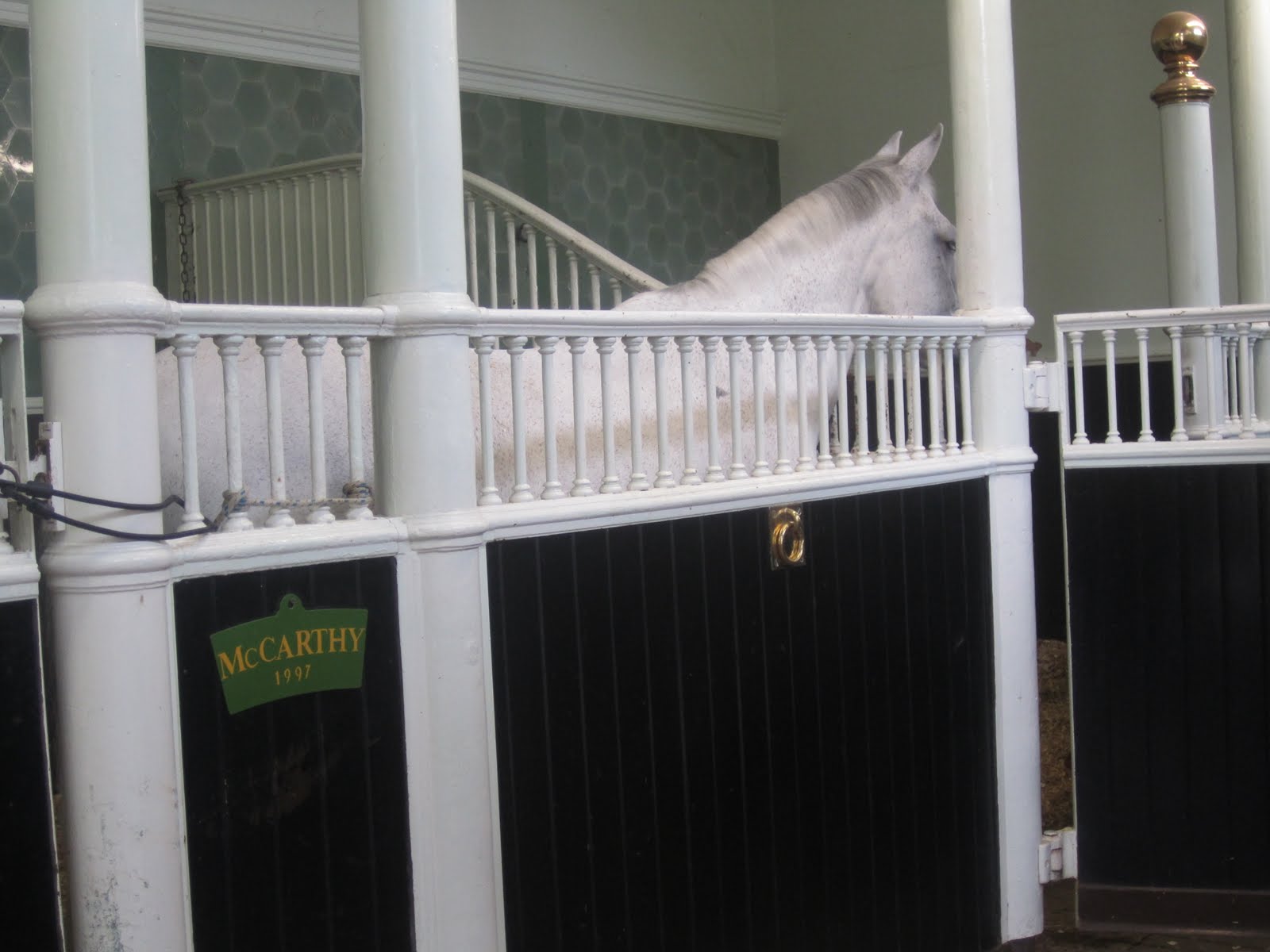
  My plan was to see the new exhibit at Buckingham Palace the includes Kate's wedding dress and other memorabilia from the Royal Family but unfortunately tickets sold out and I decided to venture into the Royal Mews.  Adjacent to the Palace, the Royal Mews functions as a working and living department for members of the Royal Household.  All aspects of familiar travel are their prime responsibility.  Horse-drawn carriages are the best way for the Royal Family to be seen in public with the elaborate rich decorations and style.  The Royal Mews is mainly responsible for the special honorary occasions such as coronations, jubilees, the State Opening, the Queen's birthday, and many more.  The large part that is open to the public is visited by 100,000 people each year.  It's purpose is not to serve as museum but a working establishment involving the training of horses and care taking of carriages.  Depending on the occasion, different carriages are used to fit the attire.  For example, a Barouche is made for fine weather, drawn by light, and elegant horses as opposed to the Charabanc that is designed for group outings such as picnics.  All the carriages were beautiful but one particularly stood out and that was the Gold State Coach commissioned by George III.  It has stunning gold covering the outside and the detail is surreal.  On each corner there is a golden carved triton representing power in all it's might.  Also on display was the Scottish State Coach that the present queen had used on her 60th birthday.  The horses used to pull the carriages are Windsor Greys and there are 10 out of  30 at the Royal Mews as of now.  Eight Windsor Greys pull the Gold State Coach and have to go through large amounts of training to do so.  These horses are treated as well as the Royal Family appears to be.

-Taylor Gentry


The Tower of London

By Arlicia McGhee


  During the mini break, I had the opportunity to visit the Tower of London.  I was expecting a tower similar to those read in fairy tales like Rapunzel, instead, I was received by a medieval, royal palace.  The tower was first built by William the Conqueror in the early 1080s and has been occupied by other monarchs like Henry III, Edward I and their courts.  Not only was the tower a palace, it is best known as bloody dungeon and fortress.  What I found interesting was most famous prisoners were able to live in comfort, while others were less so.  For instance, Sir Walter Raleigh’s prison was decorated to please his and his family needs, and he was also given the opportunity to receive guest and wander the courtyards.  Unfortunately, prisoners like Henry Walpole were tortured and you can even see the imprints of messages written in the tower walls by these suffering guests.   Even though I enjoyed the entire tour, the greatest exhibit by far was the viewing of the Crown Jewels and coronation regalia.  The 23,578 gems that make up the Crown Jewels are securely protected within the tower while being locked behind a steel vault in the Jewel House.  There has only been one attempt to steal the jewels in 1671 by Irishman Colonel Blood who was almost successful until discovered at the last minute.  I was able to gaze at crowns worn by every reigning monarch and my favorite was the small diamond incrusted crown worn by Queen Victoria.  I wish I was able to take pictures of these magnificent jewels because it was a spectacular sight to see.

 The Tower of London
Saturday afternoon after walking the London Bridge, Carra Wells and I had the chance to visit the Tower of London across the street. The Tower of London is one of the most beautiful and exciting museums in London. The building is over hundred years old and holds many of Royal British history. My favorite part of the tour and I’m sure a lot of others would agree is the crown jewels. The queue was terribly long to see the crown jewels but it was worth it by the time we made it to the front. I think that the jewels are breathtaking and I would be honor to wear them. I was impressed to find out that the Tower of London was a house, a part of parliament, a prison, and a zoo that kept a varitey of exotic animals. The tower is known now to be a popular tourists area in the United Kingdom and I recommend everyone to go visit.

                                                                                   --Kaprisha Fields


Friday, July 29, 2011

Titanic Exhibit

As a girl who had a major crush on Leonardo DiCapro circa 1997 I couldn't leave London without going to the Titanic Exhibit. Jennifer, Jessica, Adam and I went back in time to 1912 to experience what life was like during the Titanic and what was found after the boat sank.


Upon entry we each were given a boarding pass of an actual passenger that was on the Titanic. My passenger was Mrs. Louis Albert Hippach who was traveling with her daughter. Mrs. Hippach had just lost her twin sons in the Chicago Iroquois Theater fires and was trying to deal with her loss by traveling. The ladies were given first class arrangements after originally wanting to board another ship and the attendents encouraging them to stay on the boat through a bribe. At the end of the tour you could look up your passenger and see whether or not he or she survived.

The exhibit featured over 300 artifacts ranging from currency to door knobs and everything in between. It taught you about the different classes on the ship and told you interesting facts about what life was like during this time. The exhibit brought you through a step by step process of everything from the building of the ship to who survived the ship. The exhibit ended with how most of these artifacts were found through Expedition Titanic 2010.

The Titanic was led by Captain Edward Smith who had planned to retired but was talked into being captain one last time. The ship had first through third class along with lots of crew members. The price of a ticket ranged from 8 pounds to 525 pounds (today these tickets would be equivalent to 536-34150 pounds). The first class were wealthy business owners. Second class passengers consisted of more middle class people such as teachers and third class were mainly European immigrants trying to go for a better life in America. As I walked around and learned about all the differences in each class I realized at the end that most of the first class people survived out of everyone, including "myself" Mrs. Hippach.

The exhibit was very fascinating and I would recommend it to all. It is at the O2 at North Greenwich tube stop.The exhibit was extended through September 29th because of its popular demand. It cost 13 pounds and the hours vary depending on the day. For more information go to The Titanic Exhibit. Although I didn't get to see "Jack and Rose" I was happy to have been able to experience Titanic for myself.

By: Amber Rutland

The National Gallery

Today I went to The National Gallery in search to see paintings by Vincent van Gough. I am happy to say I was successful with my findings. I got to see several of his paintings. Vincent van Gough has been one of my favorite artists and to see his work was an amazing opportunity.  My favorite paintings on showcase were Van Gough’s Chair, Farm near Auvers, and Sunflowers.  According to the description at The National Gallery Van Gough’s Chair was said to represent his plain-speaking power. I was really excited to see this one because I have been familiar with this work since my high school art class.  The Farm near Auvers painting is one that he crafted a month before his death, and according to the musem the art work of the sky suggests that the painting was never finished. I was fascinated with the fact that this was one of his last works and there I was staring at what he never had the chance to finish. The painting Sunflowers was a beautiful painting that I absolutely loved. According to the museum Van Gough actually had this painting hanging in his guest room for the arrival of his friend, artist Paul Gauguin.  All of his works are beautiful and his style is original. I was amazed to stand two feet away from his paintings, and I acknowledged the brush strokes and the beauty of his talent.
For more information on Vincent van Gough at The National Gallery go here.
By Jessica Thompson