Wednesday, July 27, 2011

British Museum


The British Museum
(2/2 required Museum Visits and Writing Summary)

I can honestly say this is one of my favorite museums in London so far. Free Admission is a nice perk, but there are so many wonders of ancient history sprinkled across the museum and even more modern artifacts and exhibits tastefully woven throughout the massive multi-leveled complex. Although a bit overwhelming, the British Museum houses some of the most important pieces of mankind's history including, but definitely not limited to, the ancient mummies and tombs of Egypt, pieces of the Roman Parthenon, the Rosetta Stone, Grecian precious metals and crowns, beautiful Japanese pottery and so much more.

Aside from the more historical pieces, there was one exhibit that really caught my attention at the British Museum in the Living and Dying themed exhibition hall. This exhibit criticized and commented on the healthcare system by documenting every single medicine pill a specific man and woman had taken in their lifetime, from common cold and allergy pills even through chemotherapy treatment pills. Every single pill was laid out across a table which created a massive impact, visualizing how much we put into our bodies with medicine, but also how medicine has extended our lifetime. Here a pictures from this exhibit:


By: Anna White

Tuesday, July 26, 2011

South London Press

   South London press is not your typical British newspaper. If anything, it seems as though it has a more small town feel like our very own Hattiesburg American. With 11 nationwide newspapers in the UK, South London Press is one of the few local newspapers, covering only parts of South London. As a result of the small town vibe, the paper has stayed out of the controversy of the nationwide publications and the Murdoch scandal. The paper has even managed to not report on the topic because as Hannah Walker, the editor of the South London Press puts it, if it does not concern the community, then it should not go in the regional paper. The paper covers areas of family, schools, and generally anything that concerns the community.
  It is an independent production that has been around since 1865 and is currently owned by Tindle Newspapers. The paper comes out twice a week with an informative publication on Tuesday and an entertainment edition on Friday, just in time for the weekend. The press also puts out free editions including The Mercury and two different versions of The Post, which both deal with different areas.
   Despite the different publications, the staff at South London Press is relatively small and the majority of them work on all of the publications instead of focusing on a single paper. The staff also is extremely well-rounded. If you know how to write, you must also know how to design, and if you know how to design, you must know how to edit.
Everyone on the staff was extremely sociable and eager to answer any of the students questions.
   The size of the staff does not affect sales; however, with the majority of the publications reaching over 30 thousand readers and The Mercury at over 70 thousand.
   Though it seems with every other news organization we have been to is cutting back on print publications and amping up their websites and mobile applications, South London Press is making no efforts to do the same. Walker says they will never go completely online because as a local newspaper, they are up to somewhat different standards than other national, more up to date newspapers.
   The papers are incredibly involved in the community and show this by reaching out and creating organizations such as Our Heroes. In Our Heroes a member of the community is nominated for doing some particularly courageous every week. Furthermore, the press is making a strong effort to get young people more work opportunities so they will be more equipped at finding jobs.
   The press is aimed at making the community happy and giving them a voice. They always find a way to make a story localized so that the people in the community will see how it affects them.

The Somerset House

By Arlicia McGhee

Today, I went to the Somerset House, which is a major arts and cultural centre in the heart of London and viewed the Courtauld Gallery.  This gallery is considered one of thefinest small museums in the world.Actually, I thought it reminded me of a mini Louvre in which the rooms are engorged with paintings on every wall.  Interestingly, some of the paintings shown at the gallery are on lent from the Louvre.  This exhibit consisted of Impressionists paintings by artists such as Van Gog and Cezanne.   There was also other pieces of art like sculptures and a showing of silver used for hot drinks and about the houseduring 1710 to 1751.  The collection extended from the Renaissance to the 20th century. My favorite piece was Adam and Eve.  In this painting Adam is shown before the Tree of Knowledge and scratching his head in indecision to whether he should accept the apple from Eve or obey God and refuse the forbidden fruit.   Although all the art was breathtaking, I think most people were drawn to the exhibit: Toulouse-Lautrec and Jane Avril: Beyond the Moulin Rouge.  I really enjoyed this collection because I was able to look at the interpretation of women performers during this period.  Also, it was very informative I learned much about the relationship between Avril and Toulouse.  After viewing the paintings, I would like to rent the movie when I return home, never having seen it before. 

Welcome to Ireland

  Day one of London Away begins with a cold but pretty walking tour around Dublin. Starting at the famous statue of James Joyce, who was considered one of the most influential novelist and writers of the early 20th century, we made our way around some of the most historical monuments. The Spire of Dublin was stunning with it's incredible pin-like figure reaching around 120 meters into the sky.
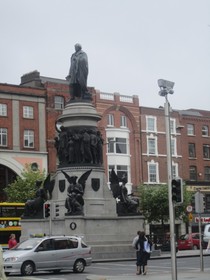
Earning the name the "Monument of Light" it is the worlds tallest sculpture. What our tour guide didn't tell us is the number of nicknames it has throughout the city like "the stelleto of the ghetto." On the same street stands another famous monument of Daniel O'Connell, a liberator who strongly campaigned for the Catholic Emancipation.
He had an extremely large part in banning personal laws and discrimination. His body is buried in Ireland yet his heart is said to rest in Italy. Also on O'Connell street is the General Post Office where most of the fighting took place in 1916. If you look at the walls there is still indentions from bullets. We had a relaxing rest break at St Stephens Green Park that had a pretty scenery with healthy plants everywhere and ducks swimming around the pond. The old building that used to be Irelands Parliament now serves as the Bank of Ireland and was the first purposely two chambered parliament house.
It holds a large part of Ireland's history and their independence issues with the British. Right across the street, the tour lead us back into Trinity College which appealed to me because up until that point I didn't understand what a large part Trinity College had in Ireland's history. The foundation was laid in 1592 and has been the home of education to many of Ireland's most prominent figures since. It is one of the oldest and prestigious universities in the world and only in the 19th century they began admitting Catholics. Although Catholics were allowed to attend they still had to have a letter from an archbishop to fully enroll We strolled past the Gaiety theatre
that has been a hotspot for talent and entertainment since 1871. Around this street were performers singing and playing instruments that were incredibly better than expected. A well known statue is Phillip P Lynott, the frontman of an Irish rock band as seen with our tour guide.


At the end of Grafton street, the famous legend of Molly Malone is captured with her statue, leaving the scandalous ways of being a hawker during the day and a prostitute at night a mystery.
The Our walking tour ended with the beautiful scenery of the Dublin Castle that was constructed in the 13th century and at one time was home to the Irish Monarchy. The different sides of the castles are all based on different time periods.
It's not everyday that you see giant castles when just walking around the neighborhood.
  Later on after lunch we returned to Trinity College to see the Book of Kells. Just the fact it was written in the 9th century and still kept together was amazing. They only change the pages about every three to four months because given the age of the book the less handling the better. The gospel manuscript was written around 800 a.d and tells the series of events such as the Arrest of Christ, the Virgin and Child, St Matthew and St John. Originally, the book was one volume but later on separated into four. At Trinity College there were two on display, one had very elaborate art that represented the Portrait of Christ and the Eight-Circle Cross. The other volume was all text, the Great tribulation, the Lord's return in glory, and the parable of the budding fig-tree. On top of seeing the Book of Kells there was also a section from the Book of Armagh and the Book of Durrow. The exhibition not only had books on display but an area that went into more detailed information. There were facts such as the pages were made out of calves skin, colors were distracted from certain types of rock that happen to be from all different parts of the world, and what I find most interesting is that no one still knows exactly who wrote the book just that it was Irish monks. After the exhibition the class went on to the Old Library's Long room which stretched 65 meters and contains 200,000 of the oldest books from the 15th to 19th century that Trinity owns. Trinity College has quite an elaborate collection considering they can copyright any book published in Ireland and Britain. On display in the Long Room was The School of Medicine exhibition that had a wide assortment of artifacts such as the death mask of Johnathan Swift, a signature from Michael Kearney as Master in 1726, Hutchinson's Illustration of Clinical Surgery, and many portraits of people that have made a difference in the history of medicine.

-Taylor Gentry

The Tower of London

By Arlicia McGhee

Side view of the Tower of London

Henry III's Bedchamber
During the mini break, I had the opportunity to visit the Tower of London.  I was expecting a tower similar to those read in fairy tales like Rapunzel, instead, I was received by a medieval, royal palace.  The tower was first built by William the Conqueror in the early 1080s and has been occupied by other monarchs like Henry III, Edward I and their courts.  Not only was the tower a palace, it is best known as bloody dungeon and fortress.  What I found interesting was most famous prisoners were able to live in comfort, while others were less so.  For instance, Sir Walter Raleigh’s prison was decorated to please his and his family needs, and he was also given the opportunity to receive guest and wander the courtyards.  Unfortunately, prisoners like Henry Walpole were tortured and you can even see the imprints of messages written in the tower walls by these suffering guests.   Even though I enjoyed the entire tour, the greatest exhibit by far was the viewing of the Crown Jewels and coronation regalia.  The 23,578 gems that make up the Crown Jewels are securely protected within the tower while being locked behind a steel vault in the Jewel House.  There has only been one attempt to steal the jewels in 1671 by Irishman Colonel Blood who was almost successful until discovered at the last minute.  I was able to gaze at crowns worn by every reigning monarch and my favorite was the small diamond incrusted crown worn by Queen Victoria.  I wish I was able to take pictures of these magnificent jewels because it was a spectacular sight to see

Study in Sir Walter Raleigh's Prison


The Irish Times

On a beautiful day in Dublin, Ireland the Journalism class took a visit to The Irish Times newspaper. The Irish Times is known for its serious news coverage and has been around for 152 years. This paper was the first newspaper to have ever produced online starting in 1994.


When we arrived at The Irish Times we had an opportunity to sit in and listen to one of their daily news conferences. In this conference, the members discussed yesterday’s newspaper and how things were good and could have been better. They also discussed stories for tomorrow’s paper. This part of the day was most interesting to me because we got to experience the behind the scene work of the thought process that creates the paper.

Among the many topics discussed, there was one most interesting. This discussion was on Mississippi and there was not a positive thing to be mentioned. The story was based on Mississippi’s statistics of high teenage pregnancy rate, most obese state and broke. Read the full article here. It was not purposely done that this topic was discussed during our visit. I will say though, as a resident of Mississippi, these statistics where embarrassing to hear.

The rest of the day we listened to speakers who discussed their role within the paper. The foreign news editor, Paddy Smith, discussed the paper in general and some of its financial troubles. He told us that circulation is falling as well as advertising. This is especially due to the economy crash in Ireland. The fall of circulation is also falling due to the fact that people are just not reading the paper anymore and their target market is beginning to die. As well as most readers are beginning to read online. The news assistant, who spoke with us, informed us that the print issue of the company is the revenue.

The online news editor for the newspaper talked to us about the history of the online edition of the newspaper. There is and e-paper available everyday that is an exact replica of the printed editions. There is currently no subscription needed to participate with the e-paper, but there will be one soon.

Finally, we spoke with the marketing and advertising department. They told us about the importance of the advertisements for the paper. They showed us some innovated layouts and ways they have been advertising in the paper and different uses of space to help build their advertising clientele.

This was such a great experience and the class and I was happy to be able to visit The Irish Times.

For more information visit http://www.irishtimes.com/.

By Jessica Thompson

Parliament Visit

by Adam Troxtell

On the Saturday before leaving for Dublin, our class had one last thing to take care of while in the capitol: Parliament. With Westminster Abbey just across the street and Big Ben towering over it, the Parliament building is among the top icons in the city of London, and we got the chance to see the very rooms in which UK policy is determined. Upon walking into the famous building, you get the impression this is no ordinary governing building; this is because it is not.


The actual name of the Parliament building is the Palace of Westminster, and for obvious reasons. It was built by King Edward around one thousand years ago, and the King and Queen would reside in this place up until King Henry VIII. The original palace burned down, but it was rebuilt 1840-60 strictly for the use of Parliament. Hand-carved wood covers the walls and corners of the ceiling; the colors gold and red (royal colors) decorate the hallways. Portraits and sculpted busts of famous politicians of the past sit as a reminder that this place likes to remember the old days fondly and continue the legacies they have created.


The Palace of Westminster sits on the banks of the Thames,
with Big Ben directly to the right. It is an iconic image.
 There are three main parts to the Palace of Westminster: the Royal End, the House of Commons and the House of Lords. We began at the Royal office but were only allowed into the Royal Changing Room. When Parliament has just gone through a national election, the Royal Head of State (currently Queen Elizabeth) will have to officially open Parliament. So, she would change into the Royal Robes in this room, then walk through the doors down a long hallway and through a ballroom area (where some famous heads of state, including President Bill Clinton, gave speeches in the past).

Then, she would walk into the House of Lords. This used to be the ‘upper house’ of Parliament, full of dignitaries who were given their seats based on hereditary lines (hence the royal colors of red and gold lining the walls and seats). Now, it merely serves as an advisory body for the government, and seats are given to famous politicians or high ranking members of society as a sign of honor. Still, this is where the opening of Parliament has always been done, and the traditions do not end there.

Once the Queen is ready to address Parliament, she must ensure they are all present. She will send a servant to the House of Commons to fetch the nationally elected members of the UK legislature. However, once the servant arrives, he has the door slammed in his face. This is a symbolic move to show that this is a room of the people, not of Royal authority. He will then knock three times, and members of Parliament will crack open the door and be told the Queen requests their presence in the House of Lords for her speech. Eventually, they all do fit into the House of Lords and the Queen’s Speech covering what Parliament should hope to accomplish in the next session is given. This tradition comes from 1642 when King Charles I came to arrest 5 members of Parliament for dissenting the crown, and the speaker refused to go fetch them. When the King sent a servant to do the job, the servant had the door slammed in his face.

The House of Commons is green, a sign of being separate from royalty. In fact, the whole layout of the Parliament Building is a symbol itself, as the speaker of the House of Lords faces the speaker of the House of Commons when addressing his or her members. Despite this, it is difficult to imagine government policy is done in such a royal, palace-looking building.

At times it just feels the same as being in a castle once used by the highest members of the Royal Family, and that is probably because it was. Once again, the UK’s rich history creates the basis (literally) for its present and future.